

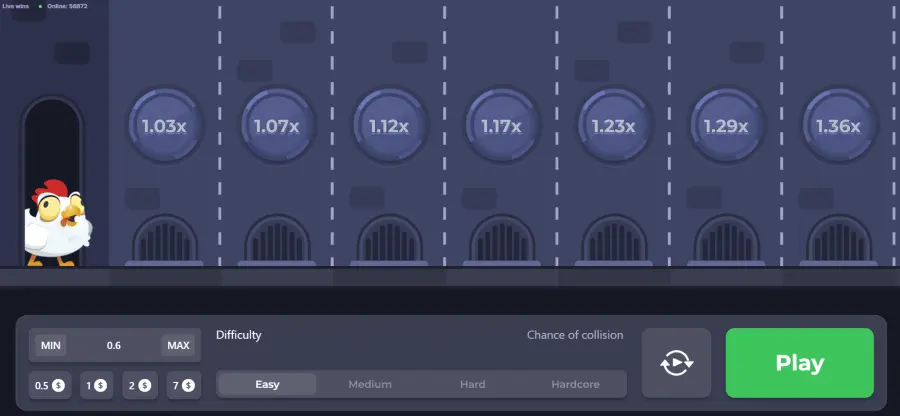




| Parameter | Value | Source |
|---|---|---|
| Provider | InOut Games | InOut Games — Chicken Road page |
| Game type | Crash-style pick-and-step mini-game | InOut Games — Chicken Road page |
| RTP (%) | 98% | InOut Games — Chicken Road page |
| Release date | 4 April 2024 | InOut Games — Chicken Road page |
| Players | Single-player | InOut Games — Chicken Road page |
| Difficulty modes | Easy, Medium, Hard, Hardcore | InOut Games — Chicken Road page |
| Demo | Available on the official site | InOut Games — Chicken Road page |
| Licence | Anjouan, Licence No. ALSI-202506032-FI2 | InOut Games — site footer |
Chicken Road Winning Approaches In INR For Safe, Fun Play
As of October 2025, Chicken road remains a simple, high-clarity crash mini-game where you advance step by step and cash out before a hazard ends the round. The official provider lists a fixed 98% RTP and confirms a 4 April 2024 release. The format is single-player and built for short sessions, making it ideal for structured risk control. Treat the Chicken road game as entertainment, not a financial instrument. Difficulty levels alter risk and potential returns, but variance is always present. A browser Chicken road demo is available for practice. Use small, pre-set stakes and strict exit rules to keep play safe.
How Chicken Road Works And What Influences Each Step
The core loop is straightforward: you pick a step, the system resolves whether it’s safe, and you may cash out or continue. Each additional step raises potential payout while compounding failure risk. Session outcomes are dominated by discipline and timing, not by chasing high multipliers. A fixed RTP means results converge long-term, but your short-term swings can be sharp. Keep Chicken road sessions short and rules consistent. In higher difficulties, expect quicker busts alongside stronger step returns. That interplay—risk versus reward—is the entire design choice.

Grid layout and hazard logic with cash out timing
The provider describes four difficulty tiers that explicitly increase “possible winning odds” while also increasing the chance of getting “fried” on each advance. This confirms that hazard density rises as you raise difficulty. A safe play is to define your cash-out step before the round starts and execute it regardless of emotion. Cashing out earlier reduces variance; delaying introduces compounding bust risk. Map your rules to mode: Easy favors conservative exits, Hardcore punishes hesitation. The Chicken road game rewards fast, pre-committed decisions. Chicken road strategy is therefore more about fixed rules than reads.
Core parameters confirmed by the official provider today
For clarity and planning, lock in the formally stated specs. The provider page lists Single-player, RTP 98%, and the 4 April 2024 release. It also exposes a Demo Play entry point, which is the right venue to test your exit rules. Legal and compliance statements appear in the site’s footer, including an Anjouan licence number for the B2B entity. These are the only parameters you should treat as factual anchors. Use them to frame session length, exit rules, and expectations. Keep Chicken road sessions aligned with those fixed attributes.
| Parameter | Value | Source | Notes |
|---|---|---|---|
| RTP | 98% | InOut Games — Chicken Road page | Fixed value (percent) |
| Release date | 4 April 2024 | InOut Games — Chicken Road page | Date format DD Month YYYY |
| Difficulty modes | Easy, Medium, Hard, Hardcore | InOut Games — Chicken Road page | Higher difficulty → higher risk and payouts |
| Provider | InOut Games | InOut Games — site | B2B studio |
| Mode | Single-player | InOut Games — Chicken Road page | Confirmation on the page |
| Demo | Available | InOut Games — Chicken Road page | Browser demo entry point |
| Licence | Anjouan, ALSI-202506032-FI2 | InOut Games — site footer | Provider compliance statement |
Betting Limits And Risk Modes For INR Players Explained
Bankroll planning matters more than target multipliers. Treat stake sizing as a percent of bankroll, not a number, to avoid overbetting as variance hits. Build rules around the four risk modes and keep those rules identical per mode. Lower modes support steadier cash-outs; higher modes are for tiny test stakes only. Keep Chicken road play inside defined time and loss boundaries. The Chicken road game is designed for entertainment and quick sessions. Focus on survival first; profit only follows discipline.
Typical bankroll setups for low medium and high risk
A simple way to structure sessions is to pre-define stake bands and exit points per mode, then rotate modes only when your rules demand it. Avoid changing rules mid-session, because emotions skew risk. Anchor your expectation to long-run RTP and short-run volatility. If you aim for learning, prioritize more rounds with smaller stakes. For confidence building, lock one exit target and repeat it. Keep Chicken road stakes proportionate to variance. The Chicken road game rewards consistency more than improvisation.
- Low-risk template: Tiny stake fraction, Easy mode, early exit on the first safe step every round.
- Medium-risk template: Small stake fraction, Medium mode, exit after two safe steps maximum.
- High-risk template: Very small stake fraction, Hard/Hardcore, exit after the first safe step or skip round if distracted.
- Recover template: After a bust streak, drop to the lowest stake and mode for ten rounds before reassessing.
Lock these templates before the session begins, then stick to them. Do not scale stakes after losses; that approach magnifies variance shock. Track results by round count rather than money to reduce tilt. End a session when you hit a time cap, not when you are “due.” Low-risk repetition is how you learn timing without pressure. Apply the same pattern in demo before live. Rehearsal in Chicken road builds muscle memory for the Chicken road game.
Responsible play controls and self imposed session boundaries
Responsible-gaming guidance from the provider emphasizes limits, breaks, and balance with other activities. Internalize that guidance by wrapping technical plans inside time and loss caps. Pre-committing to session length reduces tilt and protects budgets. Write the limits down and keep them visible next to your device. Use a countdown timer for play blocks and breaks. The Chicken road game remains fun when guardrails are firm. Chicken road play should stop on your timer, not on emotion.
- Time caps: Set a short play window and end exactly on time.
- Loss caps: Stop for the day if a fixed number of busts occurs.
- Breaks: Insert cooling-off gaps between blocks.
- Mode caps: Limit Hardcore attempts to a tiny count per session.
- Environment: Avoid play when stressed or distracted; quality beats quantity.
These boundaries work because they reduce exposure to streaks and decision fatigue. Timeboxing also keeps results from dominating the day’s mood. Mode caps prevent a slide into excessive variance. Loss caps preserve tomorrow’s bankroll and perspective. Regular breaks restore patience for early exits. Guardrails amplify the enjoyment of simple rules. With Chicken road, process discipline beats hunches in the Chicken road game.
Popular Approaches Players Use And Their Trade Offs
Common strategies are frameworks, not guarantees. The best ones minimize decision noise and keep risk visible. Low-risk methods trade excitement for steadier session curves. High-risk methods deliver bigger spikes but demand tighter money controls. Make your rule-set mode-specific and avoid improvisation. Keep a written plan beside your device. For Chicken road, predictable exits outperform spur-of-the-moment calls. Many chickenroad streaks end when plans change mid-round.
Low risk one point five exit discipline and patience
A popular conservative idea is a one-and-done, early-exit approach. You aim for the first safe step or a very small target and stop immediately. This reduces exposure to compounding risk and keeps round count high. You’ll sacrifice larger hits for smoother graphs. The plan shines during practice blocks and fatigue. It also helps rebuild confidence after losses. The Chicken road format rewards restraint here. The Chicken road game feels calmer with fixed, tiny targets.
- Decide exit before starting and write it down.
- Enter Easy or Medium and cash out on the first safe step every time.
- Run a fixed number of rounds, then pause and review results.
You’ll feel the urge to “let one ride,” but the framework works only with perfect execution. Expect small, frequent wins and modest drawdowns. Your main risk is boredom turning into rule breaks. Track adherence, not profit, during learning phases. Consider short bursts of Medium only after consistent results. Over time, this routine clarifies your timing. It keeps Chicken road tidy and tempers impulses in the Chicken road game.
High risk step ladder exits and stop loss planning
Aggressive play magnifies variance and requires unmistakable boundaries. The step-ladder concept is to scale exits by round—for example, step one, then step two, then reset. Because Hardcore punishes hesitation, pre-program your stop-loss and stop-time. Stakes must be very small, and breaks frequent. Accept that most rounds will bust and a few will carry the session. If rules slip, abandon the block immediately. Chicken road variance is not forgiving. The chickenroad thrill must stay within tiny stake bands.
- Pre-write a three-round ladder, then reset to step one.
- Use a strict stop-loss measured in rounds, not money.
- Insert a short break after any Hardcore attempt.
- If distractions appear, drop to Easy or stop.
- Never raise stakes to chase a miss.
Follow-through is the entire edge here. Without it, variance compounds quickly and wipes sessions. Keep execution short and review clips of your play to spot hesitation. If you feel speed slipping, abandon the block. Consider toggling to the conservative template for a cooldown. Above all, keep stakes microscopic on Hardcore. This keeps Chicken road fun and protects your chickenroad budget.
Fairness Verification RNG Details And Provider Compliance Checks
Provable fairness means players can verify round outcomes using seeds and hashes after play. The provider’s demo clients expose a “Provably fair settings” panel and bet history, indicating an embedded verification path. Industry-standard flows publish a hashed server seed before bets, combine it with a player seed and nonce, and reveal the server seed after the round. Players then recompute and confirm the result. This protects integrity but not variance. Keep Chicken road game expectations grounded in math. Chicken road 2 inherits the same integrity principles where implemented.
Provably fair seeds and round hash verification workflow
A typical workflow begins with a server seed hash published before a round, while you set or accept a client seed. After resolution, the server reveals its seed, and you can verify the outcome via hashing tools. This lets you check fairness independently. InOut’s demo UIs label “Provably fair settings,” signaling availability of settings and history for audits. Keep logs of your seeds for comparisons. Verification confirms integrity, not profitability. The Chicken road game remains variance-heavy by design.
Licensing and jurisdiction statements from official provider pages
Compliance statements are shown across the provider site, including the Anjouan licence number ALSI-202506032-FI2 and corporate entity IOGr B.V. These disclosures indicate B2B authorization for game supply. While operators handle player accounts and payments, the studio publishes responsible-gaming guidance and KYC/Policy pages. Rely on operator-level terms for deposits, withdrawals, and identity checks. In summary, the studio supplies content under stated jurisdiction; operators run casinos. Keep Chicken road 2 comparisons focused on gameplay, not licence scope. Treat Chicken road game access as operator-controlled.
Where To Play Legally With Demo Access On Mobile
The provider hosts a demo entry on its game page; real-money play happens on licensed casino operators that integrate the game. Operators deliver device support; the studio showcases desktop and mobile previews and provides an integration flow. For practice and strategy testing, the on-site demo is the safest venue. For live play, confirm your chosen operator’s licensing and policies. Registration & sign-in: Not applicable for a game/slot; registration occurs at the casino operator. Keep Chicken road app searches focused on legitimate operators. Avoid sideloads that misuse Chicken road game download branding.
Single player mode platforms and device compatibility overview
The official page confirms Single-player and provides a Demo Play entry point, which operators embed via web clients. In practice, this means you access the same core gameplay through your operator’s site on desktop or mobile browsers. Expect identical rules and risk modes across devices. Performance nuances are operator- and device-dependent. Always test your exit timing in demo on the device you plan to use. The Chicken road app concept typically maps to an operator’s mobile experience. Avoid unofficial Chicken road download packages.
How demo mode helps practice and manage risk exposure
Use the demo to rehearse cash-out timing and validate rule adherence without bankroll pressure. Run fixed blocks, record results, and inspect hesitation moments. Switch difficulties in demo to feel how variance changes before risking money. The provider’s page surfaces the demo entry point for this exact purpose. Demo time also helps you calibrate session caps and breaks. You do not need a Chicken road download to practice safely. Treat the Chicken road game download idea as operator-specific.
Is Chicken Road Worth Your Time And Bankroll In INR
For disciplined players who enjoy short, rules-driven sessions, the 98% RTP and transparent difficulty modes are appealing. If you need long bonus cycles or complex features, this minimal format may feel sparse. Because variance is real, the best experience comes from strict, pre-written exits. Third-party review hubs cover the title and its sequel, but rely on official specs for facts. Try the demo first, then small stakes. Keep Chicken road game sessions short. Compare impressions with Chicken road 2 game before committing.

Expert and player review signals summarised for India
Independent review hubs describe Chicken Road as a burst/crash mechanic with a clear step-and-cash-out loop. They frequently highlight the high RTP and the simplicity that suits quick sessions. Availability for Indian players depends on operator licensing and geoblocks; always verify locally. As a discipline exercise, the game fits structured bankroll plans. For deep features, consider other genres. Keep Chicken road game expectations grounded. Compare notes against Chicken road 2 game content.
Pros and cons based on verified features and facts
The official specs—RTP, release date, and modes—make it easy to design rules that match your risk tolerance. Demo access allows safe rehearsal of exits and session caps before spending money. A visible responsible-gaming stance and provably-fair tooling in demos support transparency. The minimalist, step-or-exit design concentrates decision-making where timing matters most. The trade-off is that variance is still significant, especially in higher modes, so losses can cluster despite “good” decisions. Keep planning first. Chicken road game benefits from structure.
- Fixed 98% RTP and four difficulty modes are officially documented, letting you align rules with clear, stable parameters instead of guesses.
- Provably-fair settings and bet history in demos enable after-the-fact verification, supporting trust and post-session analysis.
- Variance spikes at higher difficulties; clusters of quick busts are common and will punish loose execution even with good plans.
- Demo access on the provider page makes it easy to rehearse exits, test devices, and stress-test boundaries before risking money.
- Simple, fast rounds favor pre-committed, repeatable strategies and short sessions that fit responsible play habits.